
Best Teen Banking Accounts 2026: Top 5 Picks
June 17, 2026 · ParentRankings Editors
Our Top Pick
Greenlight
Greenlight is the most complete teen financial platform available, combining real-time merchant-level spending controls, chore and allowance management, savings goals, and beginner stock investing in a single app — nothing else comes close for families who want genuine financial education alongside parental oversight.
Back-to-school season has a way of making financial reality hit all at once. NerdWallet refreshed its own teen checking account rankings as recently as June 9, 2025, which tells you something: this is a category that parents are actively searching right now, and the options keep evolving. High schoolers are landing first jobs, getting behind the wheel, and starting to talk about college. The window to build real money habits is not "someday." It's this fall.
The stakes are higher than most parents realize. A teenager who graduates high school knowing how to budget, save toward a goal, and avoid overdrafting has a genuine edge. A teenager who graduates with an established credit history has an even bigger one. The right teen banking account does not just hold money; it teaches. And the wrong one, usually a bare-bones debit card with no educational layer and no parental visibility, does roughly nothing except give your kid a way to spend at Chipotle unsupervised.
We evaluated five accounts on the criteria that actually matter to families: parental controls, fees, ease of use, financial education quality, and credit-building potential. Here is what we found.
What to Look for in a Teen Banking Account
Parental controls and safety are where we start, because an account you cannot monitor is not a teen account, it is just a bank account. The features that actually matter are merchant-level blocking (not just category-level), instant push notifications for every transaction, and FDIC-backed deposit protection. "Real-time visibility" sounds like a marketing phrase until your 15-year-old makes a questionable purchase at midnight and you want to know about it before breakfast.
Fees and overall value deserve more nuance than a simple free-versus-paid comparison. A monthly subscription is worth scrutinizing, but a platform that delivers chore management, savings goals, and fractional share investing alongside the debit card is a genuinely different product from a free account that offers none of that. The question is not whether you are paying; it is whether what you are getting justifies the cost.
Ease of setup and daily use sounds obvious until you realize how many perfectly functional accounts your teen will simply ignore. An intuitive app matters. Frictionless onboarding matters. Features the teenager actually engages with voluntarily, not because you told them to, matter most of all. A debit card collecting dust in a wallet is not financial education.
Financial education quality is the criterion that separates the serious platforms from the ones just riding the teen banking trend. The best accounts embed learning into the actual banking experience: fractional share investing, in-app lessons, savings bonuses, and credit-building tools that work in the background. The goal is a teenager who understands money, not just one who can swipe a card.
Credit and future-readiness is the long game, and most parents underestimate how early it starts. Teens who arrive at 18 with an established positive credit history have a measurable head start on apartment applications, student credit cards, and car loans. Only one account on our list actively builds that credit profile from day one, and it is worth knowing about before your kid turns 16.
Who Should Buy
If you want the most complete parental control and financial education platform available, our top pick is the answer. Merchant-level spending blocks, chore and allowance management, savings goals, and beginner stock investing all live in a single app. The monthly fee is real, but so is what you get for it. For families who want genuine oversight and genuine learning, nothing else on this list comes close.
If your teen is 16 or older and you are already thinking about life after high school, our credit-building pick deserves serious attention. It is the only free account on our list that starts building a real credit history from the moment it opens. Your teen could have years of positive payment history on file before they ever need a student loan or sign an apartment lease. That head start is worth more than any savings rate.
If you want real-time spending visibility without paying a monthly fee, our free monitoring pick delivers instant per-transaction push notifications and category-level spending controls at zero cost. It is not as feature-rich as our top pick, but for parents whose primary concern is knowing where the money is going, it does the job.
If your family already banks with one of the nation's largest institutions and wants the simplest possible setup, our bank-backed pick connects directly to your existing account with no new banking relationship required and access to thousands of fee-free ATMs nationwide. Setup takes minutes. Friction is minimal.
If your teen is a hands-on learner who needs financial concepts explained rather than just a card to spend with, our financial education pick weaves budgeting and investing lessons directly into the banking experience. Teens learn in the context of their own real money, and a strong savings rate rewards the habits those lessons build. It is entirely free, which makes it the strongest pure value on the list.
More Picks We Love
Our full ranking, scored by our editorial team on safety, value, ease of use, and quality.
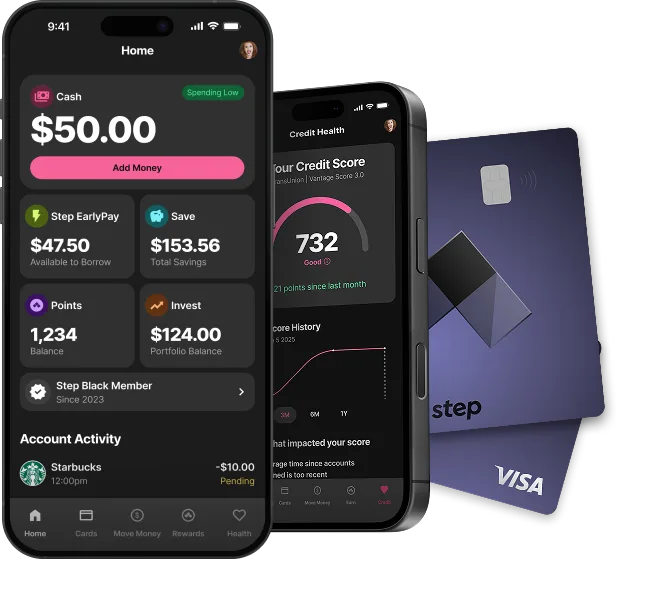
Step
Step is the only free teen account that actively builds a credit history from day one, meaning your 13-year-old could walk into adulthood with years of positive credit already on file — a head start that no other account on this list can match.

Current
Current gives parents the clearest real-time window into their teen's spending of any free account, with instant push notifications per transaction, category-level blocking, and an optional 4% APY savings bonus — all without paying a monthly fee.

Chase First Banking
For families already banking with Chase, First Banking is the seamless, zero-friction choice — it plugs directly into your existing Chase account, taps 16,000+ fee-free ATMs, and carries the institutional trust of the nation's largest bank.

Copper
Copper earns its financial education badge by weaving budgeting and investing lessons directly into the banking app itself — teens learn in the context of their real money — and the completely free model plus a 5% APY savings rate make it the strongest value pick on this list.
Frequently Asked Questions
Can a teenager open a bank account without a parent?▾
In most cases, no. Minors under 18 typically cannot open a bank account independently because they cannot legally enter into a financial contract. Almost all teen banking accounts — including every option on this list — require a parent or legal guardian to be a joint account holder or custodian. The good news is that the joint structure is exactly what enables parental controls and spending visibility.
Do teen debit cards affect a teenager's credit score?▾
Standard teen debit cards do not build or affect a credit score because they draw from existing funds rather than extending credit. Step is the notable exception on this list — its secured Visa card reports positive payment history to credit bureaus, actively building a credit profile from the day the account opens. For all other accounts here, credit building doesn't begin until the teen opens their own credit product after turning 18.
What happens to a teen banking account when they turn 18?▾
Most teen accounts transition to a standard individual checking account when the account holder turns 18, at which point parental controls and joint access are typically removed. Some platforms, like Step, are designed to grow with the user into full adult banking. It's worth checking each provider's transition policy before you open an account so there are no surprises when your teen reaches adulthood.
Is a fintech teen account like Greenlight or Step as safe as a traditional bank?▾
The deposits in fintech teen accounts are generally FDIC-insured up to $250,000 because these companies partner with FDIC-member banks to hold customer funds — Greenlight partners with Community Federal Savings Bank, for example. That said, the fintech company itself is not a bank, so it's worth confirming the specific banking partner and FDIC pass-through insurance status for any account you open. Chase First Banking, as a product of JPMorgan Chase, is directly FDIC-insured with no intermediary.
How much do teen banking accounts typically cost?▾
Teen banking accounts range from completely free to around $5.99–$14.98 per month depending on the platform and tier. Among our top picks, Step, Current, and Copper are entirely free. Chase First Banking is free for families with an existing Chase checking account. Greenlight charges a monthly subscription starting at $5.99 for up to five children, which covers its expanded feature set including investing and chore management. There are no accounts on our list that charge overdraft fees, since teen accounts are structured to prevent spending beyond available balance.
Ready to compare all options?
See every teen banking ranked by our editors — scored on safety, value, ease of use, and quality.
See all 5 Best Teen Banking Accounts ranked →